
- January 3, 2026
Part I — When Refill Becomes a Daily Operational Burden
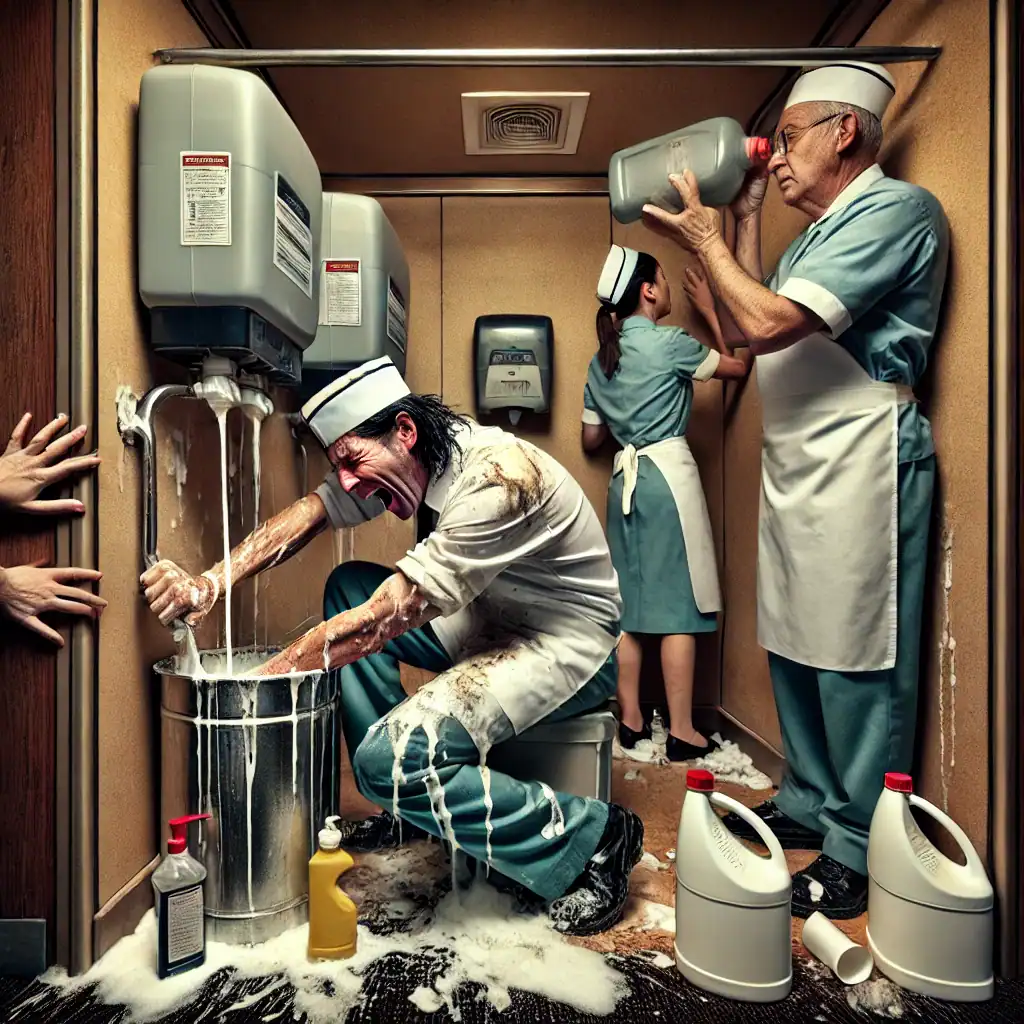
This is Part I of a five-part series on designing refill as an operational system in hospitality. The picture above is AI-generated.
Refill was never meant to be complicated.
In theory, it is one of the simplest tasks in hotel operations: top up a bottle, put it back, move on.
In practice, it has quietly become one of the most fragmented, repetitive, and underestimated routines in the entire housekeeping operation.
And that gap, between how refill is perceived and how it is actually performed, is where problems begin to accumulate.
The invisible work behind sustainable intent
As hotels transitioned away from single-use amenities, refillable systems were introduced with good intentions: reduce waste, improve sustainability, align with guest expectations.
What received far less attention was what this shift meant on the floor.
Refill today often involves a sequence of manual actions that demand handling, attention, and cleanup — carried out in workspaces that were never designed for the task itself.
Individually, these actions appear minor. Repeated dozens of times, every day, by different people, under time pressure — they become something else entirely.
Not just a time issue. But a question of physical effort, mental load, and consistency.
Improvisation as the default operating mode
In many hotels, refill routines are not designed – they emerge.
They are shaped over time by necessity rather than intent, adjusted locally to “work well enough” in the moment.
These routines persist because:
they rarely fail outright
they sit below formal reporting
their impact is absorbed by frontline staff
But improvisation is not flexibility. It is often a sign that responsibility has shifted from the system to the individual.

Refill rarely happens where it was designed to happen. Most of the time, it happens here.
When each refill depends on personal judgment and effort, the operation becomes:
variable rather than repeatable
difficult to train consistently
fragile when scaled across teams or sites
What appears adaptable is frequently just unstructured.
Why this is not a sustainability problem
Refill is often discussed through sustainability metrics: plastic reduction, waste avoidance, ESG targets.
Those outcomes matter, but they are downstream effects.
Upstream, refill is an operational routine. And operational routines succeed or fail based on how often they are repeated, how much variation they allow, and how much effort they demand.
When refill is treated primarily as a sustainability initiative, its operational reality is easily overlooked. The result is a process that technically functions, but quietly erodes flow, consistency, and staff experience.
Sustainability does not undermine operations.
Undesigned operations undermine sustainability.
The burden no one planned for
Housekeeping teams did not sign up to be process designers. Yet they are the ones compensating daily for routines that rely on attention rather than structure — filling the gaps left by unclear standards and inconsistent tools.
This burden rarely appears in reports or dashboards. But it shows up in fatigue, errors, and friction.
Refill becomes “just one more task” — until its cumulative weight begins to affect the rhythm of everyday work.

Manual refilling often requires staff to manage details they were never meant to manage — accuracy, cleanliness, and consistency — all at the same time.
Refill deserves to be taken seriously
The issue is not that refill is difficult. The issue is that it is repetitive, distributed, and taken for granted.
And in operations, those are precisely the tasks that demand the most deliberate design.
There is no single workaround that fixes this.
The issue is structural — not procedural.
Before discussing solutions, systems, or technology, it is worth acknowledging this: Refill is no longer a background activity.
It is a daily operational reality. And realities like that should never be left to improvisation.
We pay attention to routines like refill because they reveal how work actually gets done – not how it is described on paper.
When everyday tasks begin to rely on attention, experience, and improvisation, it is rarely a people problem. It is a design problem. This series exists to better understand that distinction.
More information:


