

- January 18, 2026
Part III — Measuring What Matters: ROI from Time Saved, Mental Load, and Physical Work
This is Part III of a five-part series on designing a refill system as an operational tool for sustainable refilling of bathroom amenity products.
Return on investment is often discussed in terms of time saved and costs reduced. And yes, those are the numbers everyone wants to see first.
So let’s start there.
In practical terms, using the refill machine cuts the total time spent refilling bottles — including handling, unscrewing and replacing the pump — by roughly half. Across a day, a week, or a month, that difference adds up quickly — not as an abstract efficiency gain, but as reclaimed time that can be redirected to other tasks, in an environment where there is always more to do and where time is the most valuable resource.
At common refill volumes, the machine investment pays for itself well within a year. These figures are straightforward. They are easy to communicate and easy to defend. But they only describe the visible surface of the work.
Time is the most valuable resource
In housekeeping operations, time is the most valuable asset. When one task takes longer than expected, something else has to give.
That “something else” is rarely a low-value activity. It’s often:
- a control step that gets rushed
a break that becomes shorter
or a task that quietly moves to the next shift
This is where the right equipment helps keep the workflow steady, so each task can be completed at a sustainable pace.

Studying time and flow in the refill process when developing the refill system, focusing on consistency rather than speed alone.
Cognitive load
Most ROI evaluations bypass cognitive effort. But anyone who has worked in housekeeping knows how real it is.
Manual refilling demands constant attention and micro-decision:
- monitoring fill levels
- adjusting pressure
- preventing spills
- keeping bottles consistent
None of these questions are difficult on their own. But repeated hundreds of times per day, they create fatigue, inconsistency, and errors.
By designing refill as a constrained process — where the system itself prevents mistakes — cognitive load drops significantly. The task becomes predictable. Mentally quieter.
That has a return too:
fewer mistakes
more consistent outcomes
less end-of-shift exhaustion
In comparative tests, automated refilling reduced that mental demand significantly. Users were able to briefly shift attention without compromising accuracy, while consistency remained high and the risk of mistakes decreased.
Lower cognitive load isn’t a “nice-to-have.” It directly affects error rates, interruptions, and how smoothly tasks fit into the broader flow of housekeeping work — all of which influence operational stability.
Ergonomics and physical strain
When a task is easier on the body, it becomes easier to sustain. That impacts:
- injury risk
- sick leave
- retention
- onboarding of new staff
The physical effort behind manual refilling is often underestimated. Refilling 30 empty bottles manually requires physical work equivalent to carrying a heavy cabin bag up several floors in a single session.
Repeated pumping places strain on hands, shoulders, and neck, and heart rates during the task reach well above resting heart rate.
With machine-assisted refilling, that strain drops sharply. Pumping is eliminated, posture remains neutral, and physical stress stays lower throughout the task. Heart rate remains close to resting level.
Over time, this reduces fatigue, lowers injury risk, and supports a more sustainable working pace — particularly important in high-turnover environments.

On-site testing during development, working alongside hotel staff to observe and evaluate repetitive movement patterns in real operating conditions.
Operational analytics
Refill routines generate data — about usage, consumption, refill frequency, and how work is actually carried out over time. When that information is captured systematically, it gives operations teams something they rarely have today: a clear, factual picture of consumption versus purchasing, variation between sites or shifts, and how structured the work really is.
This kind of insight enables better planning, more accurate forecasting, and more informed conversations between housekeeping, management, and procurement — not by adding reporting work, but by making existing routines observable.
Just as importantly, it allows teams to see how efficiently and consistently the work is being done, creating a shared reference point for improvement without relying on assumptions.
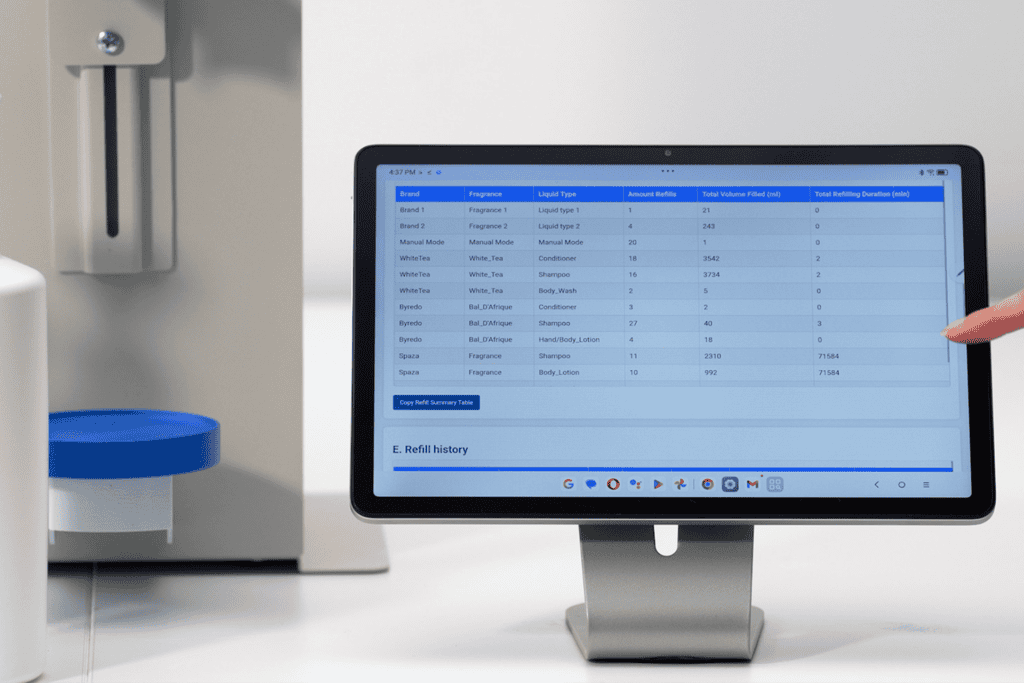
Making refill operations visible — enabling better planning, forecasting, and alignment across teams through real usage data.
Chains and Corporate
For hotel groups and large corporate hospitality operators, scale changes the equation.
When operations span multiple properties, teams, and shifts, small inefficiencies multiply. Variations in refill routines, hygiene practices, or physical strain, become systemic risks.
Working in a structured way with efficiency, ergonomics, hygiene, and human factors creates several downstream effects at scale:
- Standardized routines that reduce variability between sites
- Improved compliance and audit readiness
- More predictable labor planning and workload distribution
- Lower physical and cognitive strain across large, rotating teams
In corporate environments, this structure create conditions where quality, safety, and well-being are maintained consistently — regardless of who is on shift or which property is being reviewed.
When systems support people instead of compensating for manual workarounds, both performance and the work environment become easier to sustain over time.
From an operational perspective the refill machine is essential. It creates the conditions needed to maintain quality, precision, and staff well-being — regardless of who is on shift.
Director of Services of a large Corporate Hotel
Increased Performance
The return of cognitive and ergonomic design shows up as:
- reduced mental strain during repetitive work
fewer errors and less rework
reclaimed time that can be used where it’s needed most
- more sustainable physical routines
calmer, more predictable daily operations
These are harder to quantify — but impossible to ignore if you care about how work actually gets done.
When work feels easier to manage, performance becomes more reliable. When physical strain drops, endurance increases. And when teams feel that their daily reality has been properly understood, engagement follows naturally.
This is the total ROI: not only faster refills, but better work — sustained over time.


