

- February 5, 2026
Part IV — Refill in Everyday Operations: Experiences from the Field
This is Part IV of a five-part series on designing a refill system as an operational tool for sustainable refilling of bathroom amenity products.
Over time, we’ve worked closely with hotels observing their refill routines and speaking directly with operations teams. Alongside this, we conducted a market study to understand their current routines and how the refill system are perceived and adopted at scale.
This article brings those perspectives together.
Different Hotels. Same Operational Reality
On the surface, hotels look different.
Different layouts.
Different room counts.
Different operating styles.
Yet when it comes to refill, the reality is similar.
No matter the environment, the task always comes down to the same fundamentals: the same milliliters to fill, the same time pressure, the same need for consistency — repeated shift after shift.
The most effective operations we see from our customers have quietly solved the working environment for refill, with the machine in center they also ensured:
- good lighting and ventilation
- access to water and drainage
- clear space for empty bottles
- defined storage for filled bottles
- protective gloves and basic ergonomics
- practical surfaces to work from
These details consistently showed up where refill worked exceptional well.
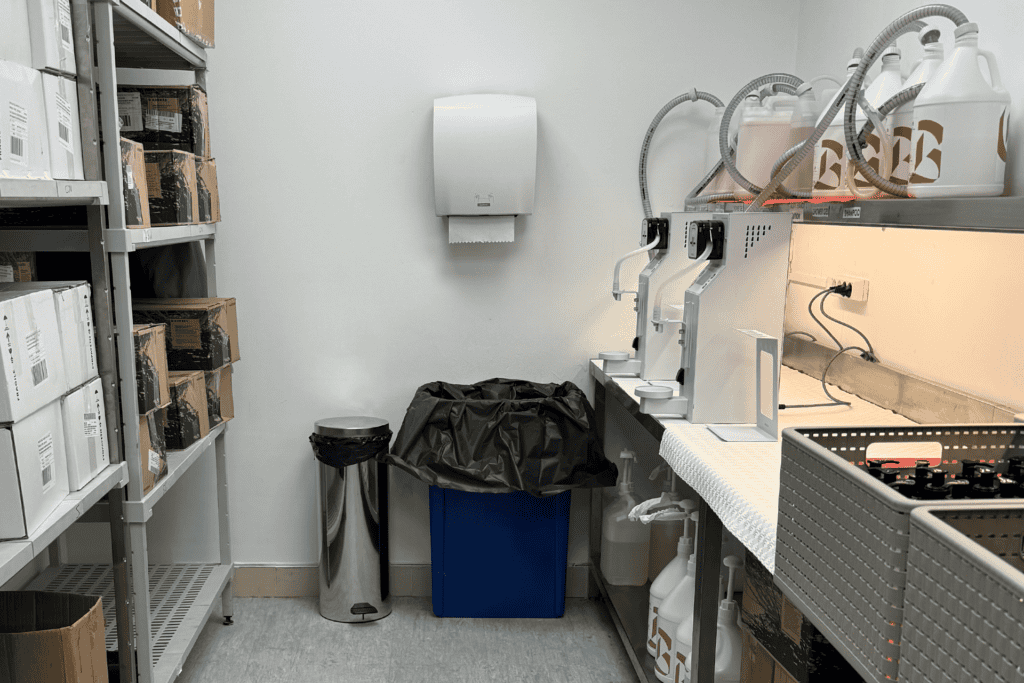
When refill works exceptionally well, the environment around the task is already solved — lighting, space, flow, and the right tools in place.
What Changes When Refill Is Treated as a System
In environments where refill was approached as a defined operation rather than a neccessary evil, the same pattern appeared:
- One clear setup
- A predictable and measurable sequence of actions
- Fewer corrections and adjustments
- The same outcome, regardless of who performed the task
No extra effort. Just fewer and reliable variables.
A Brief Note from Our Market Study
What we observed on the floor was reinforced by our market study.
Hotels that had moved to the smart refill machine described their experiences as:
- a clear upgrade in perceived quality
- something staff quickly accepted as “the normal way” of working
- an investment that paid for itself quickly — largely because of the functionality presented to them, not because of added controls or pressure
Several respondents highlighted the system raised the perceived level of professionalism in daily work — not just the final result in the room.

A close look at the smart refill machine — described by hotels as a clear upgrade in perceived quality and a natural part of daily work.
What This Means for Operations
Taken together, interviews, observations, and market feedback pointed to the same conclusion.
When reliable tools and procedures are provided:
- staff confidence increases
- supervision needs decrease
- quality becomes more consistent
- ROI shows up in everyday operations — not only in spreadsheets
This is the point where refilling stops being a sustainability initiative and starts functioning as an operational capability.
From Pilot to Instant Insight
For hotels that want to explore our system further, we usually start in a very straightforward way — with a pilot.
A pilot will let operational teams try the system in real conditions, and quickly realize what it means for them. Typically, the process is:
- a machine is delivered and installed
- the liquid products are setted up in the machine
- teams are able to get started within minutes
The purpose of the pilot isn’t to prove that refill works — that’s already known.
It’s to align on practical questions together:
- how many machines are needed
- what (if any) room adaptations need to be made
- how to introduce and involve frontline staff early
No long-term commitments.
Just a structured way to see what changes when right tools is in place.
If you’d like to learn more about the market study, the system behind these observations, or how a pilot works in practice — we’re happy to share more.


